Public Key Cryptography What-why-how

Symmetric encryption uses a single shared key for each encryption and decryption, which is faster however requires securely distributing that one key upfront. This system ensures that solely the meant recipient can read an encrypted message and that a signed message actually comes from the claimed sender. Public key cryptography is essential for safe internet communications, permitting for confidential messaging, authentication of identities, and verification of data integrity.

email cryptography

Public Key Cryptography Benefits

  • When someone needs to ship protected information, they use the recipient’s public key.
  • It is Sooner and more efficient for resource-constrained units.
  • As the name implies, the public key can be shared publicly, often in a repository or directory.
  • For instance, a enterprise name and URL are essential attributes for certain digital certificates.
  • Just to stop suspicion, Eve might encrypt the e-mail encryption key again utilizing Bob’s publickey so that it can be decrypted by Bob.

Since the whole web depends on these protocols being adopted, it is extremely difficult to alter an established protocol. That is why there has not been any giant degree of change in older protocols corresponding to e-mail to afford higher privacy. As A Substitute, it’s easier to vary the transmission technique or change the content material of messages that aren’t wanted for delivery. As A Outcome Of of this difficulty with large key spaces, brute pressure isn’t used towards encryption. Somewhat, the algorithm used to create the encryption is explored to search for weaknesses that can establish flaws. Or, mathematical attacks are used to find out and attempt extra likely keys.

Algorithms

These units can take many varieties however are usually referred to as https://www.suscinio.info/the-beginners-guide-to-6/ keys. The time period Cryptography stems from the two Greek words means hidden and writing. A extra concrete example is seen in an encrypted clay recipe from Mesopotamia circa 1500 BCE. When it involves creating safe conversations over the Web (via HTTPS), public key cryptography may be very useful. The public key of a website is found in its publicly shared SSL/TLS certificate, whereas the non-public secret is installed on the origin server and is “owned” by the website itself.

public key cryptography example

Pkcs #8 – Non-public Key Data Syntax Standard

The story of this discovery was stored secret for an extra 24 years. In 1997, Clifford announced to a convention the true historical past of the event of public key cryptography, and various internal stories were declassified to support the story. Alas, Ellis, whose authentic idea it had all stemmed from, died a few months earlier than the announcement. Cryptoki serves properly in situations that require single sign-on and disk encryption techniques. Certificate authorities use it to access https://villaspeople.net/how-to-stay-connected-abroad-without-high-costs/ the CA’s signing key and to generate new certificates.

Why Are Public And Private Keys Important?

Even though the communication was despatched over the web, it’s nonetheless safe as a outcome of only Bob has access to the non-public key. Sending a secret Message − Alice wish to talk with Bob in personal. Even if someone intercepts the message, they will be unable to learn it without Bob’s non-public key as a outcome of solely Bob’s private key can decode that message. Public key cryptography authenticates the server and securely exchanges a session key through the initial TLS handshake, but it’s too sluggish for ongoing knowledge transfer. The session key then permits fast symmetric encryption for the remainder of the connection, combining the strengths of both strategies.

RSA has been the industry standard for public key cryptography for a quantity of years now. If you’re nonetheless questioning the place to start or the method to put these greatest practices into motion, we’re right here to assist. As organizations adopt stronger encryption, automation, and post-quantum readiness, managing cryptographic keys securely and at scale becomes more and more advanced. We help enterprises at every stage of their encryption and key management journey, helping translate greatest practices into operationally sound and future-ready architectures.

Cryptography Nist

For instance, for image classification, a convolutional neural network is essentially the most normal community structure. In this section, we introduce two mannequin buildings that involve sequence and tree buildings, respectively. At Present, cryptographic protocols are utilized in quite a lot of important conditions and are indispensable technologies. For example, TLS 1.3 is used for confidentiality, tamper detection, and authentication of communication partners on the Web https://taxwhistleblowers.org/bip39-bitcoin-self-custody-and-u-s-crypto-taxes-why-secure-seed-phrases-matter-for-financial-compliance.html 39. Vulnerabilities in cryptographic protocols can compromise communications over the Internet and tamper with digital transactions. The influence is serious, and subsequently the safety of cryptographic protocols is necessary.

  • Many algorithms can’t be applied on a single platform, and whereas optimization efforts corresponding to accelerator reuse exist, additional analysis is required to help transitions from conventional public-key cryptography to post-quantum cryptography (PQC).
  • It is predicated on the hardness of the NTRU problem and is designed to be efficient in both software program and hardware implementations.
  • The first is producing a dataset for coaching a machine learning mannequin utilizing formal verification (Figure 2a).

2 Formal Verification Of Cryptographic Protocols

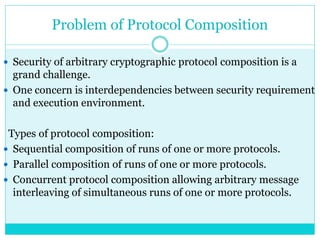
A protocol is simply a algorithm or instructions that determine tips on how to act or work together in a given scenario. A cryptographic protocol is designed to allow safe communication underneath a given set of circumstances. The cryptographic protocol most familiar to internet customers is the Secure Sockets Layer (or SSL) protocol, which (with its descendant the Transport Layer Safety, or TLS, protocol) protects bank card numbers and other delicate information, and which offers the lock image in your browser’s handle bar to let you understand that you can trust the connection.

cryptography basics

Examine On Cryptographic Protocols

cloud security solutions

Requirements similar to FIPS a hundred and forty or Common Criteria validate cryptographic primitives, key administration logic, and firmware. Any change to those components can invalidate certification or require pricey and time-consuming recertification, making operational cryptographic updates technically attainable but typically infeasible. From an agility perspective, this means that replacing or deprecating a single algorithm usually has cascading results across the protocol. Poorly designed protocols tightly couple cryptographic selections with message codecs, key sizes, or control flows, making future transitions disruptive or even infeasible.

The Position Of Cbom In Enabling Strategic Crypto Agility

The most elementary mannequin taking a fixed-length vector as an input is called multi-layer perceptron (MLP). Vectors computed within the deep studying model are called latent vectors of the enter knowledge and thought of to represent advanced features of the information. Relying on the construction and prior information of the enter information, an acceptable mannequin structure should be chosen.

Ssl/tls Handshake: Guaranteeing Secure On-line Interactions

These lifetimes can exceed the anticipated security lifetime of the algorithms, key sizes, and protocol constructions initially selected, creating a fundamental rigidity between system durability and the flexibility to evolve cryptography over time. Many algorithms cannot be carried out on a single platform, and whereas optimization efforts similar to accelerator reuse exist, additional analysis is required to assist transitions from traditional public-key cryptography to post-quantum cryptography (PQC). Future cryptographic algorithm designs must account for these hardware useful resource limitations to remain sensible and deployable. Supplier and third-party dependencies characterize a big cryptographic agility risk, so choices should account for vendor support, update practices, and the agility of third-party parts. By addressing these components, organizations can be sure that cryptographic transitions are anticipated and planned, rather than executed under disaster conditions.

Software & Api Security

Best for organizations looking for automated API security from improvement to runtime. It’s good for these who prefer standalone safety or want to mix it with ThreatX API & Application Protection – Edge solution. It is very suitable for enterprises looking to streamline API management and security operations, ensuring seamless integration with their current infrastructure and expertise stack. This flexibility allows organizations to leverage the benefits of Akamai API Safety no matter their present infrastructure, guaranteeing comprehensive safety throughout diverse environments. Collectively, they provide international protection, boasting enterprise-wide visibility and complicated behavioral analysis.

app security solutions

## Tools & Options For Api Security

breakthroughs in cryptography, medicine, and ai.

This consists of cell apps, cloud-native and cloud-based functions, net applications, and software program as a service (SaaS) apps. API security is a form of cybersecurity that covers the protocols, processes, and finest practices for securing software programming interfaces (APIs) towards data breaches, unauthorized entry, and different threats. Fundamental gateway and cloud controls can suffice, however https://codefortots.com/novosti/why-your-social-security-tax-withholding-isnt-exactly-6-2-of-your-paycheck/ as API exposure, sensitive information, or associate integrations develop, a dedicated API safety answer becomes essential to guard trust and resilience. A platform spanning cellular, web, cloud, and API security with continuous scanning, posture checks, and runtime protections, designed to bridge gaps across software layers. It centralises analytics across clouds and groups, and streamlines developer workflows and adoption.

### Safety Configuration Administration

  • NGWAF presents seamless integration with SIEM platforms like Elastic and Datadog, empowering users with priceless insights to bolster their safety posture and optimize resource allocation.
  • Beyond the standard issues like price and ease of integration, a number of other crucial components ought to be taken into account when deciding on API safety instruments.
  • If you already have a WAF in place and want advanced API-specific visibility, a standalone device complements it.
  • Require clear residency and sovereignty options, isolation mannequin particulars, and auditable knowledge paths.
  • This characteristic facilitates the comparison of API traffic towards specifications, serving to organizations establish and mitigate compliance gaps effectively.

When preventing botnet attacks, the objective is to make it exhausting and costly for attackers while fixing vulnerabilities. The issue of API security ownership is fraught with fragmentation amongst numerous teams, complicating the state of affairs additional. In Accordance to the survey, the landscape is a mixture of varying perspectives, with 38% of respondents assigning ownership to the CISO, whereas 25% said that development and/or DevOps were the stewards of API security.

Prolong Information Security To Apis

To guarantee sufficient coverage, choose an API security vendor offering comprehensive safety against varied threats, together with abuse of privileges by reliable users. This signifies that threats are detected and mitigated immediately with out the necessity to send information to separate instruments for analysis. With WAAP, there’s no delay in protecting net applications and APIs, guaranteeing environment friendly and effective security measures. A dedicated API security platform is a specialised answer to protect APIs from numerous threats and vulnerabilities. These platforms/appliances usually offer full security measures and capabilities tailored particularly for API safety.

Organizations choosing starter or benefit plans might lack complete managed support, impacting their ability to effectively mitigate threats and optimize security operations. With layer 7 DDoS capabilities and rate-limiting performance, F5’s Distributed Cloud WAAP ensures the provision of net apps and APIs by effectively mitigating DDoS assaults on the utility layer. F5 is uniquely positioned to ship API management, high-performance API gateways, and advanced safety controls within a single answer, decreasing device sprawl and architectural complexity. Imperva API Safety offers steady safety through indepth discovery and classification of delicate data. Detailed logging of API requests, together with headers and other related particulars, enables simple troubleshooting and supplies insights into visitors patterns. Integration with reporting and syslog modules further enhances visibility, facilitating prompt detection of surprising habits.